And why unverified bolting tools represent an underestimated risk
In many companies, the same principle still applies: as long as the tool works, it continues to be used. Calibration is often postponed, treated as optional, or only performed when required.
This is exactly where a frequently overlooked risk begins. Because when it comes to bolting tools, one thing is clear: what is not verified cannot be controlled.
Torque tools are designed for precision, but in reality they are subject to continuous wear. Regular use, mechanical stress, and environmental influences gradually affect their accuracy. The critical issue is not just the deviation itself, but the fact that it remains invisible. A tool can feel perfectly normal and still deliver inaccurate results.
These seemingly small deviations can have significant consequences. If a bolt is not tightened to the required preload, the joint may loosen during operation or be subjected to uneven stress. On the other hand, excessive torque can lead to material strain or even damage to the connection. Especially in sealing applications or safety-critical environments, this can quickly result in unplanned downtime, increased maintenance costs, or even safety risks.
Experience and a good feel for the tool may support daily work, but they cannot replace measurement accuracy. Deviations in torque are not perceptible to the user, particularly within critical tolerance ranges. Without regular verification, the entire bolting process lacks a reliable reference.
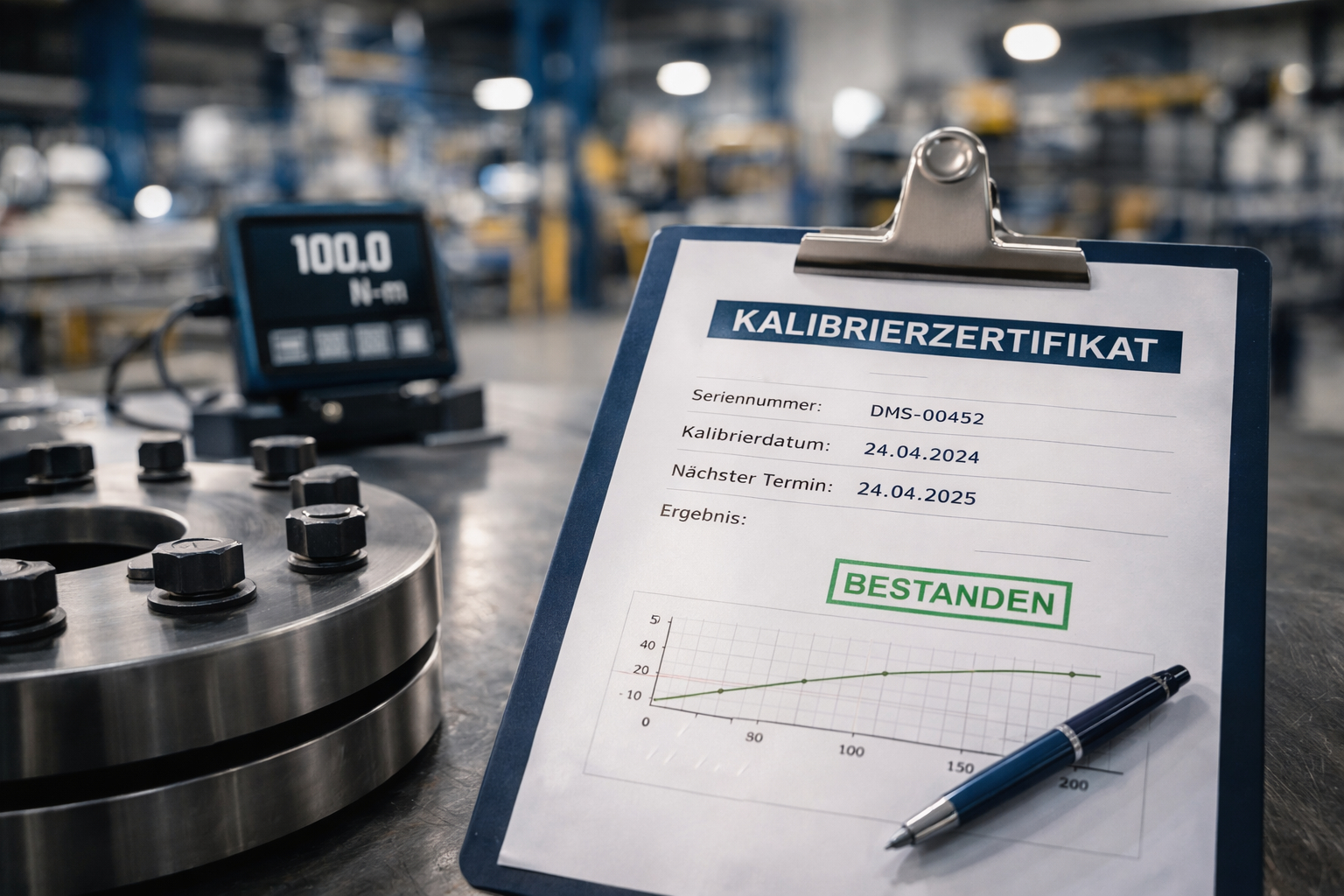
This is where calibration comes into play. It ensures that tools operate within defined tolerances and that results remain consistent and reproducible. At the same time, it builds trust in the process, as every bolting operation can be traced back to controlled and verified conditions. In addition, documentation and quality requirements are becoming increasingly important across industries.
The more demanding the application, the more critical calibration becomes. In sectors such as energy, heavy industry, and plant engineering, calibration is no longer optional—it is a fundamental requirement for safe and stable operations.
Beyond safety and quality, regular calibration also offers a key advantage that is often underestimated: predictability. Companies that calibrate their tools at defined intervals reduce the risk of unexpected failures and create a stable foundation for maintenance and production processes.
Ultimately, calibration is not an additional effort—it is an essential part of a controlled bolting process. Companies that neglect it introduce uncertainty into their operations. Those who prioritize it establish the foundation for quality, efficiency, and long-term reliability.
Or put simply: calibration does not cost money – skipping it does.